Fargo Fire Chief Gary Lorenz with Flag Family News Reporter Chris Larson
FARGO, N.D. – Fargo Fire Chief Gary Lorenz has been on the job since July and it has been a very busy year with many different projects both completed and ahead for the department.
Lorenz spoke with Flag Family News to talk about his career in Grand Forks, recap 2025 in Fargo and look ahead to 2026.
Looking back on career in Grand Forks
While it’s his second stint with the Fargo Fire Department, the department is not a new place for Lorenz. He returns to head the department after a successful run in Grand Forks as its department chief.
“I have nothing but good things and respect to say about my time at Grand Forks. I spent seven years up there, learned a lot, met a lot of great people,” he said. “Coming back to Fargo, stepping back into the station, especially downtown here, that I was a part of the remodel for and coming back kind of into our own offices and recognizing a lot of the old pictures, the old faces. It’s been a little nostalgic for me. I’m very pleased to be back.”
Reflecting on 2025
Regardless of how long he’s served in Fargo in 2025, it’s been a busy year, Lorenz said.
One of the biggest highlights was the citizen vote that passed the Public Safety Sales Tax (PSST).
“The firefighters here locally put tons of their personal time out on the streets, talking to people, promoting the sales tax that ultimately passed for public safety here,” he said.
The department also received accreditation through the Commission on Fire Accreditation International, a program of the Center for Public Safety Excellence. The fire department was first accredited in 2010 – and then every five years after that.
“Every five years you go through the re-accreditation where you upload your documents and your performance indicators,” Lorenz said. “And then a peer team of assessors comes into the city for four days and reviews all of your things. And this was the fourth time we did our re-accreditation.”
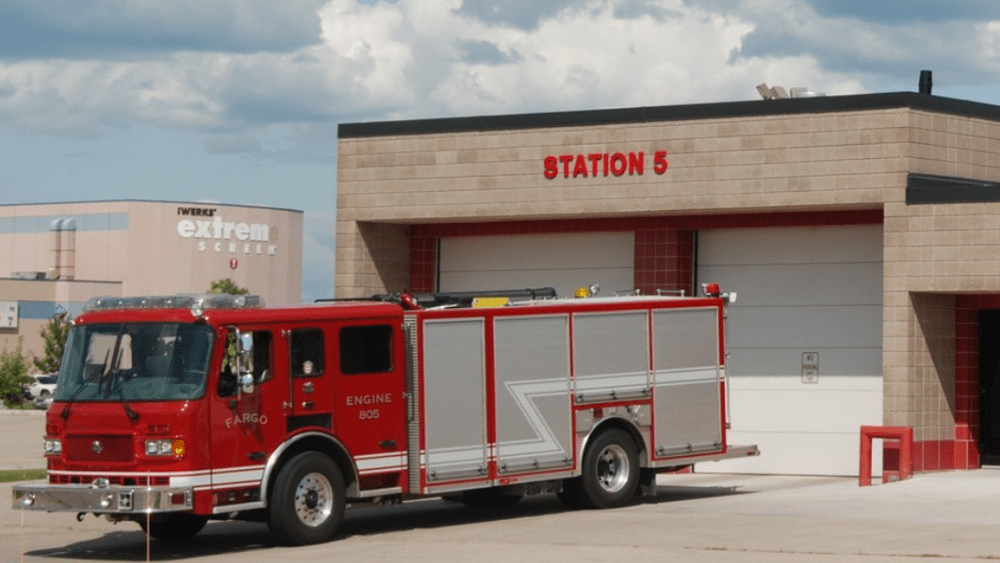
The department also completed reconstruction of Fire Station 5, which is located on 40th Street South, which began in 2024. Lorenz said the station had structural issues. The living areas were torn down and rebuilt, with the reopening happening this year.
A new fire engine was put into service at Fire Station 1 in downtown Fargo, with a refurbished unit being placed in Fire Station 5.
“(We are) trying to always find ways to save money and reutilize resources,” Lorenz said. “It was a refurbished where you pulled the body off it and put a new chassis and cab underneath it.”
The department is also working to update their alerting systems to stations, as the company who installed and maintained the system is no longer in service, and equipment for the system was failing.
Lorenz said that project will wrap up in 2026.
The department will also benefit from the new Red River Regional Dispatch Center, which has been moved to their new facility in the Fargo Industrial Park.
“That not only serves the fire department, but it serves all of the public safety agencies in Cass and Cass County of North Dakota and Clay County of Minnesota,” Lorenz said.
He said there are not many dispatch centers that serve two counties in two different states, a unique situation
The Fargo, Moorhead and West Fargo Fire Departments have also graduated their 13th graduating class of the Metro Fire Academy.
Looking ahead to 2026
With a growing community and legislative changes, Lorenz looks forward to what’s to come in 2026.
Among the challenges is being diligent about Fargo Fire Department resources when it comes to the legislature’s three percent property tax cap implemented this year.
“Even though we were fortunate that the local community supported public safety here with the sales tax, that property tax cap is going to mean tightening our belts here in our emergency response services,” Lorenz said. “The cost of things in our world have just went up exponentially. One big challenge is fire apparatus themselves. What used to cost $500,000 five years ago is now a million dollars.”
The cost of the apparatus alone is forcing the department to utilize their resources to their fullest capacity, he said, but also meeting the expectations of the Fargo community.
“They’re supporting public safety,” Lorenz said. “So we have to meet all of those needs that they expect of us, but we also have to do it as fiscally responsible as we can.”
The department is also prioritizing completion of a facility study on multiple buildings – including the training facility, which was built in 1966.
“The burning building and our tower, they’ve just reached the end of their life,” Lorenz said. “They’re kind of really starting to degrade. They’re becoming past the point where we can use them safely anymore.”
The department hosts a minimum of two recruit classes each year, along with approximately 240 hours of ongoing training per firefighter each year.
“We use it every day,” Lorenz said.
Records management is also being updated nationally, which means systems locally need upgrading.
“Our previous record management system didn’t do the update, and so we were forced to come up with a new record management system for all of our incident records,” Lorenz said. “That’s going to be a big challenge.”
Calls for service, employee numbers rise in 2025
The Fargo Fire Department responds to not only fires, but medical calls and other non-fire related calls.
Across the eight stations, the department is staffed 24-hours-a-day with 141 full-time employees.
That’s going to increase in 2026, including a quick response unit.
“So far we’ve been able to get applicants,” Lorenz said. “We’ve been able to keep everything staffed, but it is a challenge. It’s not as easy as it was 20 years ago.”
Recruitment and retention is not just an issue locally, but also regionally and nationally.
“We just don’t have the number of people stepping up wanting to do these positions anymore,” Lorenz said.
Despite the challenges, the Fargo Fire Department remains well-equipped and well-prepared to meet the community’s, and region’s, needs.
“Everybody comes to work every day to do the best job that they can,” Lorenz said. “I’m very proud of this organization. The community should be very proud of our department. We really have great employees that pride themselves on serving the community.”
Even though the year has yet to end, the Fargo Fire Department has responded to approximately 14,600 calls. The majority – between 70 and 75 percent – are for Emergency Medical Services-related calls. That includes motor vehicle accidents, cardiac arrest or any type of medical assist.
“Generally, if somebody calls 9-1-1 and the dispatch center is not sure who to send, they’ll send the fire department,” Lorenz said. “We really are an all-hazards organization, and we’ll respond and try to handle, if we don’t know how to handle it, we’ll try and get the right people there.”
Fargo has one of four regional hazardous response teams.
“We provide, for the southeast region of North Dakota, a response for hazardous materials and the structural collapse,” Lorenz said. “It takes a ton of training to maintain those skills and proficiencies, but it’s a service that we’re not only providing for the city, but for the region as needed.”