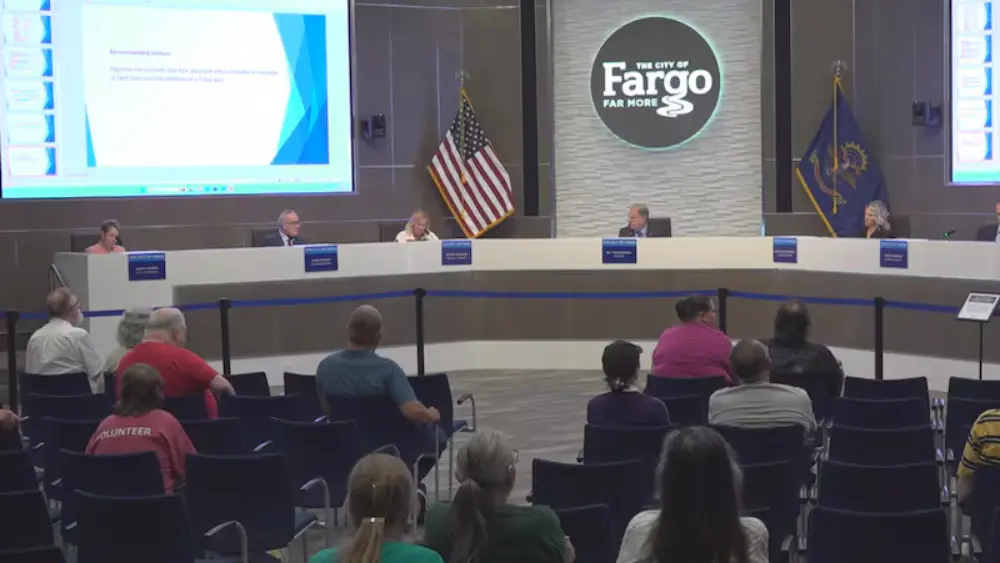
FARGO, N.D. – The City of Fargo’s Engineering department updated the Fargo City Commission on two projects during its meeting this week.
The projects are the 12th Avenue North bridge and the 40th Avenue South pedestrian bridge. Both of these bridges are over the Red River.
12th Avenue North bridge
City Engineer Jeremy Gorden said the 12th Avenue North bridge is ‘relatively low in nature.’
The project is a federal one.
“So, there’s a purpose and need for every federal project we do. The need is it’s built too low to withstand major floods over the Red River Valley, and we need to reconstruct it to a higher elevation,” he said. “The deficiencies are pretty obvious, but it’s flood prone, poor pedestrian access in the area, tying into the parks, poor pavement, and then the intersection operations at Elm Street are failing at times.”
The bridge goes underwater when the Red River hits a flood stage of 27 feet.’
The project is funded by a $1.5 million grant from the U.S. Department of Transportation for project development.
But Gorden said there’s a lot of challenges – including a potential issue with parks on both sides of the project.
“When you have federal funds potentially affecting park land, you have to step very softly and make sure everything is analyzed and the end product ends up being a benefit to the parks,” he said.
The alignment of the project in North Dakota remains unchanged. In Moorhead, the alignment that currently exists is ‘going to end up too close to the housing’ that’s south of the road.
“So, it will get shifted a bit to the north,” Gorden said. “There’s more room there and it can really stay on city-owned land.”
The project is estimated to cost between $27 million and $30 million to construct. No local funds are set aside for the project.
40th Avenue South pedestrian bridge
The 40th Avenue South pedestrian bridge project was adopted as a part of the Go2030 Comp Plan adopted in 2012. It was also identified in Fargo’s bike gap study in 2019.
The bridge would connect both sides of the river and would be built permanently above the 100-year floodplain, Gorden said.
“This would not be lifted,” he said.
The project cost is approximately $7 million and contains multiple funding sources, including federal aid in both North Dakota and Minnesota.
The project is currently in the design phase, with plans set to be completed this spring. The bidding would then happen in the winter of 2026 and construction ultimately on tap for the spring of 2027, with completion in the spring or summer of 2028.