
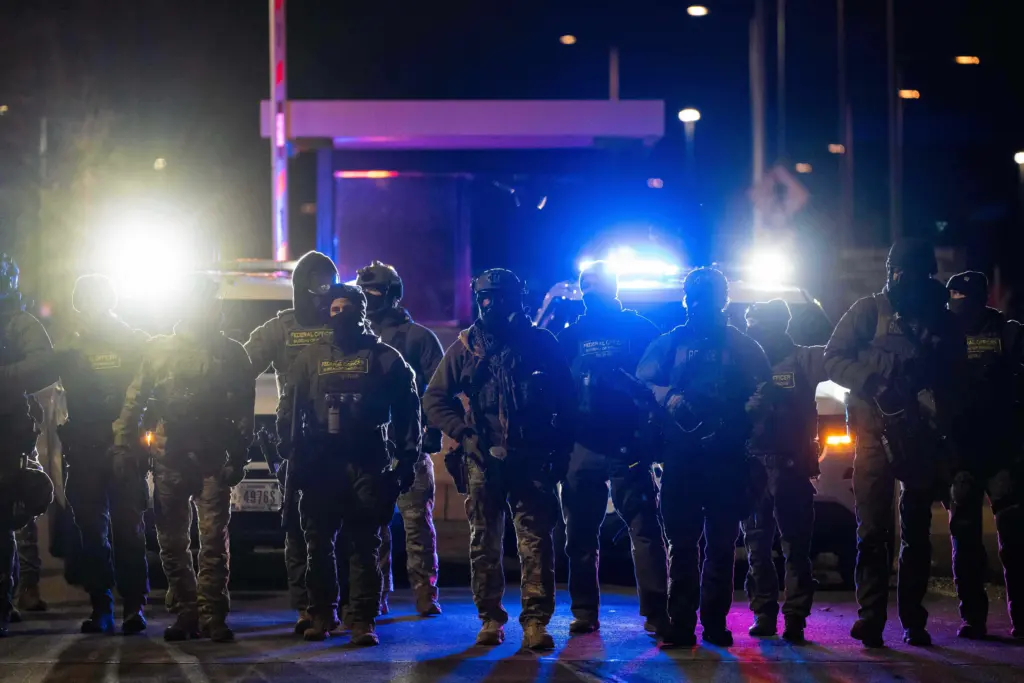
MINNEAPOLIS (AP) — A federal judge heard arguments Monday over Minnesota’s challenge to the Trump administration’s immigration enforcement crackdown, posing skeptical questions to both sides about the effort that has led to two fatal shootings by federal officers.
U.S. District Judge Katherine Menendez is considering whether to grant requests by the state and the cities of Minneapolis and St. Paul to temporarily halt the immigration operation. She said the case was a priority, though she issued no immediate ruling.
Menendez questioned the government’s motivation behind the crackdown and expressed skepticism about a letter recently sent by Attorney General Pam Bondi to Minnesota Gov. Tim Walz. The letter asked the state to give the federal government access to voter rolls, to turn over state Medicaid and food assistance records, and to repeal sanctuary policies.
“I mean, is there no limit to what the executive can do under the guise of enforcing immigration law?” Menendez asked. She noted that the federal requests are the subject of litigation.
Lawyers for the state and the Twin Cities argued that the situation on the street is so dire as to require the court to halt the federal government’s enforcement actions.
“If this is not stopped right here, right now, I don’t think anybody who is seriously looking at this problem can have much faith in how our republic is going to go in the future,” Minnesota Assistant Attorney General Brian Carter said.
Brantley Mayers, a Justice Department attorney, said the government’s goal is to enforce federal law. Mayers said one lawful action should not be used to discredit another lawful action.
“I don’t see how the fact that we’re also doing additional things that we are allowed to do, that the Constitution has vested us with doing, would in any way negate another piece of the same operation, the same surge,” Mayers said.
Menendez questioned where the line was between violating the Constitution and the executive’s power to enforce the law. She also asked whether she was being asked to decide between state and federal policies.
“That begins to feel very much like I am deciding which policy approach is best,” she said.
At one point, while discussing the prospect of federal officers entering residences without a warrant, the judge expressed reluctance to decide issues not yet raised in a lawsuit before her.
“I can’t be the global keeper of all things here. Like, presumably that will be litigated,” she said to the state’s attorney.
Menendez made it clear that she was struggling with how to rule because the case is so unusual, and there are few precedents in case law to guide her.
“It’s because this is important that I’m doing everything I can to get it right,” she said.
The state of Minnesota and the cities sued the Department of Homeland Security earlier this month, five days after Renee Good was shot by an Immigration and Customs officer. The shooting of Alex Pretti by a Border Patrol officer on Saturday added urgency to the case.