Flag Family’s Scott Hennen’s conversation with Karl Rove
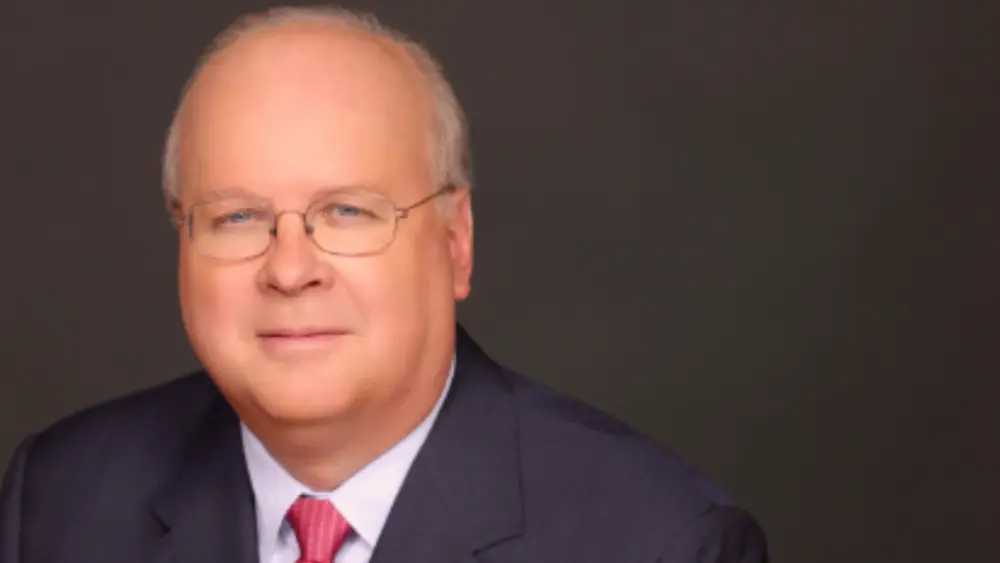
BISMARCK, N.D. — Veteran Republican political strategist Karl Rove predicts Republicans will lose control of the U.S. House of Representatives in November’s midterm elections, although he believes polling inaccuracies could make several races more competitive than expected.
Rove also discussed his relationship with President Donald Trump, divisions within the Republican Party and the historical significance of the Theodore Roosevelt Presidential Library in Medora following Friday’s “Governor Kelly Armstrong and Karl Rove In Conversation” event at Heskett Hall at the University of Mary in Bismarck.
Rove predicts Republicans will lose control of the House
Rove, a former senior adviser to President George W. Bush, said history suggests Republicans face significant challenges in maintaining their congressional majority.
“Well, I don’t think we’ll keep the House,” Rove said. “We’ve only gained seats in three modern midterm elections.”
Rove pointed to the 2002 midterm elections, when Republicans gained seats despite the historical difficulties facing the president’s party.
“Look, we’re going to lose the House. The question is by how much,” Rove said.
He suggested Republicans could lose as many as 30 seats, although he does not anticipate a 60-seat defeat.
Rove argued that dissatisfaction with Trump, rather than enthusiasm for Democratic candidates, is driving much of the political environment.
“People are not voting for Democrats because they are for the Democrats. They’re voting for the Democrats in large measure, because they’re sending a message to the president of the United States, which inevitably happens in midterm elections,” Rove said.
However, Rove cautioned that polling could be overstating Democratic support.
He cited research examining more than 3,300 polls across four election cycles that he said found Democratic support was overstated 73% of the time.
“If your poll is off three points or four points, then these are all up for grabs,” Rove said.
Rove said Republican candidates must focus on explaining their priorities to voters during the final weeks of the campaign.
He also expressed optimism about Republican Michelle Tafoya’s campaign in Minnesota, describing her as “authentic, empathetic, smart.”
Rove discusses relationship with Trump and criticism from Republicans
Rove also addressed his sometimes contentious relationship with Trump, saying his willingness to criticize the president should not be interpreted as opposition.
“Look, my job is to talk about things that I think he’s doing well and the things that I think he can do better,” Rove said.
The longtime Republican strategist said his work as a political commentator requires independent judgment.
“My job for Fox and for the Wall Street Journal is not to be a cheerleader. It’s to be a commentator to call the balls and strikes as I see it,” Rove said.
Rove recalled being criticized by Trump after publicly opposing a proposed $5,000 payment, which he argued would substantially increase the federal deficit.
“We can’t add a trillion dollars, one point two trillion dollars to the deficit,” Rove said.
He argued that the financial burden of such spending would ultimately fall on future generations.
Despite their disagreements, Rove said he does not believe Trump takes political criticism personally.
“He doesn’t take it personally and I shouldn’t take it personally either. It’s just him lashing out. And, you know, that’s how he handles it,” Rove said.
Rove also pushed back against Republicans who label fellow party members as Republicans in name only, commonly called RINOs.
He pointed to his decades of experience helping elect Republicans in Texas and other states.
“God did not give you the power to describe who’s a Republican and who’s not. That’s up to each one of us,” Rove said.
Rove discusses Trump’s political rise and growing political divisions
Rove argued that Trump’s emergence as a political force was driven largely by frustration with established political institutions.
He traced some of that dissatisfaction to the early years of former President Barack Obama’s administration and the emergence of the Tea Party movement.
Rove said many Americans believed political leaders, the media, academia and major businesses had become disconnected from ordinary working people.
By 2015, he said, those frustrations created an opening for a candidate willing to challenge the political establishment.
“And that was Donald Trump. That was his appeal. I’m one of you. I’m fed up, too. And I’ll act on your behalf,” Rove said.
Rove said Trump’s years as a television personality also helped establish a connection with voters who believed he understood their concerns.
“And here came a, you know, a wealthy New York real estate tycoon who said, I get you,” Rove said.
“They felt they had a kinship with him and that he would stand up for him. And that’s exactly why he got elected.”
Rove also discussed his concerns about political divisions, arguing that American politics has experienced similarly difficult periods throughout history.
He pointed to the 1960s and 1970s, the Great Depression, the Gilded Age and the decades preceding the Civil War as examples.
Rove praises Theodore Roosevelt Presidential Library in Medora
Rove also praised the Theodore Roosevelt Presidential Library, describing it as an important attraction for North Dakota and a meaningful tribute to the former president.
“First of all, it is an enormous attraction to bring people to the state and see how wonderful North Dakota is,” Rove said.
He praised the facility’s architecture, technology and exhibits.
“It is such a fantastic facility. They’ve used technology and design to make this an incredible place to meet and engage with Theodore Roosevelt,” Rove said.
Rove, who has extensively studied Roosevelt and President William McKinley, said the library’s location in the Badlands is particularly meaningful because of Roosevelt’s personal history in North Dakota.
Roosevelt traveled to western North Dakota following the deaths of his wife and mother on the same day.
Rove said Roosevelt’s experiences in the Badlands helped him recover from those losses and eventually return to public life.
“He came to get away. He fled. He fled the dark moment of his life, but it was here that he found his life, and he forever was grateful for it,” Rove said.
Rove noted that Roosevelt continued returning to North Dakota even after rebuilding his political career.
“He could have gone lots of other places more convenient, but he knew what this place meant to him because it saved him,” Rove said.
Rove also discussed McKinley’s role in Roosevelt’s political rise, crediting the former president with recognizing Roosevelt’s abilities and appointing him assistant secretary of the Navy.
That appointment helped Roosevelt rebuild his political career before his service with the Rough Riders and eventual election as governor of New York.
Rove said studying McKinley’s historical papers changed his understanding of the former president.
“The more I dug into them, the more I was just amazed at the character of this guy and how thoughtful he was,” Rove said.
Rove said he is working on two books, including one examining how the United States has overcome difficult periods in its history and another exploring how presidents gather information before making important decisions.